
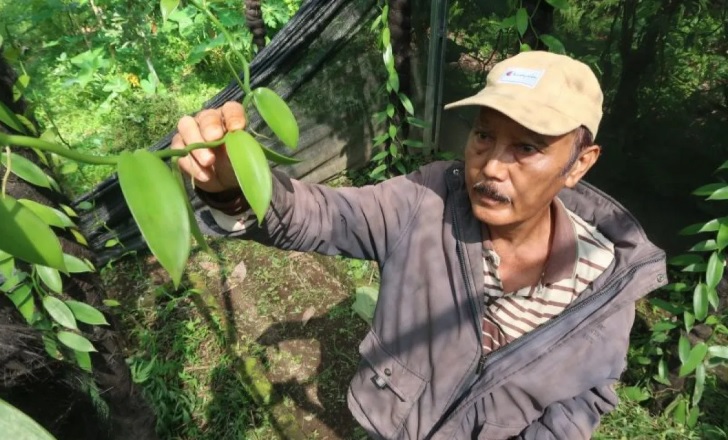
Jakarta (ANTARA) – Vanilla is more than just a spice. This high-value commodity is an essential raw material in the food, beverage, cosmetics, and pharmaceutical industries.
Indonesia is the world’s second-largest vanilla producer, with Vanilla planifolia growing abundantly in Bali, Java, Sumatra, Sulawesi, and East Nusa Tenggara. Global demand for natural vanilla is increasing rapidly as consumers increasingly value organic products and authentic flavors.
The global vanilla market is estimated to reach US$1.2 billion by 2025, while the Indonesian vanilla market is projected to grow 5.99 percent from 2024 to 2032, reaching US$33.29 million by 2032. However, this enormous potential can only be achieved if production quality and farmer welfare are improved, so that local vanilla can truly “smell the world.”
Although known since the colonial era as Java vanilla, Indonesia’s contribution to the export market is far from optimal. Indonesian vanilla exports in 2022 reached US$28.7 million, ranking sixth in the world behind Madagascar, Uganda, France, Germany, and the Netherlands. Data from the Ministry of Agriculture (Kementan) recorded dried vanilla exports in 2023 at 173 tons with a value of US$15.2 million, a sharp decrease from US$90 million in 2017. The main market was the United States (60 percent), followed by Singapore, the Netherlands, France, China, Canada, Germany, and Australia.Despite declining value, Indonesia remains the world’s second-largest producer, producing 2,306 tons, or 30.3 percent of the global total (FAO, 2020). Indonesian vanilla’s bold, smoky, and vanillin-rich flavor is a distinct attraction in the premium chocolate and perfume industries.
The price of Indonesian vanilla continues to fluctuate with fluctuations in global production. In June 2025, grade A vanilla from Indonesia was sold between US$180–220 per kilogram, while grade B was in the range of US$110–150, and grade extract was around US$80–120. These prices are indeed lower than Madagascar vanilla, which can reach US$250–300 per kilogram, but this is precisely where Indonesia’s competitiveness lies. Behind those small, sweet-scented beans lies a significant opportunity to sell not only raw materials but also high-value processed products. The Ministry of Agriculture noted that the average global price of vanilla extract reached 270.4 euros per kilogram, far above the 175.56 euros for whole beans.
This means that when farmers are able to innovate and process their harvest into extracts, powders, pastes, or essential oils, the selling price of Indonesian vanilla can skyrocket. However, behind that fragrant aroma lies a classic problem: early harvesting and poor quality. Many farmers pick vanilla pods three months after pollination, far from the ideal eight to nine months, for fear of their plants being stolen. This practice drastically reduces the aroma and vanillin content of Indonesian vanilla, making it less competitive than Madagascar’s perfectly dried vanilla, which produces a complex flavor. Worse still, high prices on the global market encourage the practice of “slashing” by speculators who purchase young pods for replanting abroad.Furthermore, the threat of stem rot (Fusarium oxysporum f.sp. vanillae) plagues many plantations. Although the Directorate General of Plantations has encouraged the use of certified seeds, land rotation, and biological agents, their implementation in the field remains limited due to farmers’ limited knowledge and costs. Furthermore, most Indonesian vanilla is still sold as raw or dried beans, leaving farmers highly dependent on fluctuating world prices. Indonesia’s export value has plummeted from US$90 million in 2017 to just US$15.2 million in 2023 due to unstable supply, weak quality standards, and a lack of food safety certification. In many producing regions, particularly on remote islands like Flores and Sulawesi, logistics issues are a major obstacle.
Behind all this, the root of the problem truly lies in the knowledge and capacity of farmers. Many farmers have not yet mastered pollination, harvesting, and drying techniques, and still struggle with pod theft. Some local governments even require village certificates to sell their harvest as a preventative measure. This situation highlights one important point: without farmer empowerment, simple technology training, and strong institutional support, Indonesian vanilla will continue to smell fragrant in the fields, but it won’t necessarily bring glory to the nation in the global market.
A crucial step in reviving the glory days of Indonesian vanilla is ensuring uniform and standardized quality. The government should follow Madagascar’s example by establishing the Indonesian National Standard (SNI) for vanilla harvesting. This regulation will help align farmers’ perceptions of the ideal harvest time and prevent speculators from purchasing young pods, which can compromise quality.
On the other hand, certifications such as HACCP, Good Agricultural Practices (GAP), and organic and fair trade certifications must be promoted to enable Indonesian vanilla to penetrate the global premium market. Global consumers now demand full transparency through traceability documents, laboratory test results, and microbial-free certificates. Government support is urgently needed, both through subsidizing certification costs and establishing regional laboratories, to ensure the implementation of international standards down to the farmer and cooperative levels. Currently, most Indonesian vanilla is still sold as whole beans, even though the true added value lies in its derivative products. This downstreaming aligns with the growing global market demand in the food, beverage, perfume, and cosmetics sectors. Simple innovations such as artificial pollination, shade systems, and the implementation of Good Manufacturing Practices (GMP) have also been shown to increase vanillin levels and reduce contamination.
Unfortunately, many farmers still lack adequate drying and post-harvest handling facilities. The curing process, from blanching, sweating, sun-drying, to conditioning, is often neglected, resulting in a loss of vanilla’s distinctive aroma. To truly “smell the world,” strengthening strategies must not stop at the farm. Many vanilla-producing areas are located on remote islands with minimal infrastructure. Narrow roads, small ships, and warehouses without refrigeration often lead to deterioration in quality before it reaches the port. On the other hand, supply chain digitization through tracking platforms, online sales contracts, and transparent payment systems can shorten distribution channels and increase the trust of international buyers. Market diversification is also necessary to reduce dependence on the United States, which absorbs more than 60 percent of exports. Countries such as Japan, Germany, and the Middle East offer significant potential if Indonesia can promote brands like “Java Vanilla” or “Pure Vanilla Indonesia,” which highlight the archipelago’s distinctive smoky flavor.With collaboration between the government, business actors, and farmers, Indonesian vanilla will not only become an export commodity, but a symbol of national pride, and truly bring honor to Indonesia’s name in the world.