
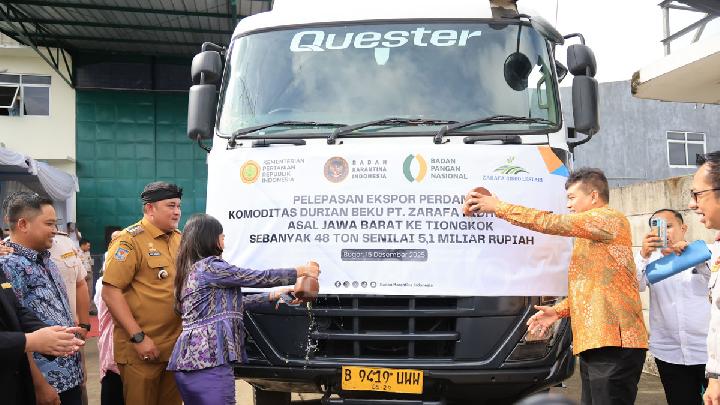
The Indonesian Quarantine Agency (Barantin) has released its first export of 48 tons of frozen durian to China, valued at IDR 5.1 billion. Prior to today’s export, the process of exporting frozen durian to China had taken almost two years.
The first frozen durian export finally materialized after the Head of Barantin, Sahat M. Panggabean, and Ms. Sun Meijin, Minister of the General Administration of Customs of the People’s Republic of China (GACC), signed the Protocol for Frozen Durian Exports from Indonesia to China on May 25.
“This is the realization of the first export of frozen durian to China, which is the manifestation of a long series of processes that take quite a long time and require the provision of considerable resources,” said Sahat during the release of commodity exports with the Bogor Regional Government and representatives of the Indonesian House of Representatives in Citereup, Bogor Regency on Monday, December 15, 2025.
The frozen durian processed in West Java will be shipped to Qingdao Port, China, via Tanjung Priok Port, Jakarta. Sahat also emphasized that this achievement is a mandate from President Prabowo’s administration, particularly mandate number five, namely continuing downstream processing to increase added value.
In this regard, Barantin is promoting this effort through its Go Ekspor program, a Barantin program that supports the downstream processing of Indonesian agricultural products to ensure their acceptance in the international market.
Barantin, Sahat said, has long been aware of Indonesia’s potential in the form of durian, a natural resource with a unique flavor and highly sought after by Chinese consumers in significant volumes. Neighboring countries such as Malaysia, Thailand, Vietnam, and the Philippines have already competed to meet the demand for frozen durian in the Chinese market.
Currently, Chinese consumers have relied on these neighboring countries for their frozen durian supply. Indonesian durian exporters are limited to supplying markets in neighboring countries, which are then processed and repackaged for export to China.
As the world’s second-most populous country, China is a major consumer of the distinctive taste of Indonesian durian. Therefore, Barantin took the initiative to communicate with the Chinese quarantine authority, the GACC, through face-to-face communication. This was followed by the Chinese government’s provision of a draft protocol for frozen durian exports to Indonesia.
Barantin intensively coordinated with relevant agencies directly involved in durian production development, namely the Ministry of Agriculture (Kementan) at the cultivation level and the National Food Agency (Bapanas) at the packaging level for Fresh Food of Plant Origin (PSAT).
Collaboration and synergy have been ongoing for nearly two years to meet Chinese government requirements, resulting in the Frozen Durian Export Protocol, signed by Barantin and GACC in Jakarta on May 25, 2025.
Meanwhile, Drama Panca Putra, Acting Deputy for Plant Quarantine, who also attended, stated that the traceability of frozen durian packaging houses through the implementation of Indonesian Quarantine Agency Regulation No. 15 of 2024 concerning Plant Quarantine Installations (IKT) and Supporting Facilities is crucial.
To date, eight frozen durian packaging houses have met the requirements for IKT designation, designated as locations for visual plant health inspections and as facilities for exporting frozen durian to China. These eight businesses have been registered with the China Import Food Enterprise Registration system: seven in Central Sulawesi and one in Bogor Regency, West Java.
Frozen durian (Durio zibethinus) that can be exported according to quarantine protocols includes durian pulp, durian puree, and whole durian fruit. Frozen durian comes from fresh, ripe durian fruit grown in Indonesia.
After being processed into pulp, puree, or whole durian, it is then frozen at -30°C or lower using an appropriate quick-freezing process, maintaining a core temperature of -18°C or lower. Frozen durian for export must be hand-selected to remove rotten and damaged fruit and ensure it is free of foreign materials.
To become a frozen durian exporter to China, one must meet certain requirements, including owning a durian orchard or partnering with a durian farmer/farmer group that has received GAP registration from the Provincial Agriculture Office. Furthermore, exporters must have a packinghouse registered with the Regional Food Safety Competent Authority (OKKPD) of Bapanas and be designated as an export facility (IKT) by Barantin.
Barantin will inspect frozen durian production, processing, and storage facilities for compliance with exporter registration requirements. Barantin will then recommend qualified companies to the GACC.
Qualified companies will be registered with the GACC. Their products can only be exported to China if they have been registered with the GACC. A critical point to consider when exporting frozen durian to China is the hygienic sanitation factor, implemented through Standard Operating Procedures (SOPs) at the IKT, to ensure that the frozen durian is free from chemical (pesticide residues), biological (bacteria), and heavy metal contamination.
Based on Barantin certification recorded in the BEST TRUST system, Indonesia exported 10,162 tons of durian from January to November 2025, in various product forms, including durian flesh, paste, and whole durians. Indonesia’s five durian export destinations were Thailand (6,003 tons), China (2,574 tons), Malaysia (1,532 tons), Hong Kong (15 tons), and Germany (6 tons). Other export destinations included Japan, Taiwan, Saudi Arabia, the Czech Republic, the Netherlands, Canada, the United States, and Norway.
Meanwhile, Aditya Pradewo, Secretary General of the Indonesian Durian Plantation Association (Apdurin), who also attended the event, revealed that business owners enthusiastically welcomed the opportunity to export durian to China. He stated that the Chinese market is a giant market for durian exporters. He also stated that demand for durian in China reaches US$8 billion, or approximately Rp128 trillion, per year.
With superior varieties like Bawor, Super Tembaga, and Namlung, Indonesia is optimistic about capturing a 5–10 percent market share. If this target is achieved, potential foreign exchange earnings will range from IDR 6.4 trillion to IDR 12.8 trillion per year.
He explained that direct exports to China not only reduce logistics costs, but also the current price of durian in China, which is 5–7 times higher than the local price, presenting significant profit opportunities for farmers and exporters.
In line with Aditya, Muchlido Apriliast, owner of PT Zarafa Ridho Lestari also said that before the Frozen Durian Export Protocol which now allows Indonesia to export directly to China, for the past few years business actors exported frozen durian to China via Thailand, spending shipping costs of US$ 18,000 per container to get to China.
Now, with the implementation of the Frozen Durian Export Protocol to China, businesses can export directly to China, spending only US$10,000-11,000 per container. This means businesses can achieve savings of around US$8,000 per container, a significant benefit, according to Muchlido.
The Head of Barantin, Sahat M. Panggabean, expressed his appreciation for the collaborative work of all stakeholders, including farmers, businesses, local governments, ministries, and other relevant institutions. “We must all prioritize collaboration and harmony to achieve added economic value that can bring prosperity to our farmers, especially Indonesian durian farmers.”
If you want to order Indonesian Durian or other Fruits , please contact Indonesian-Product.com.