
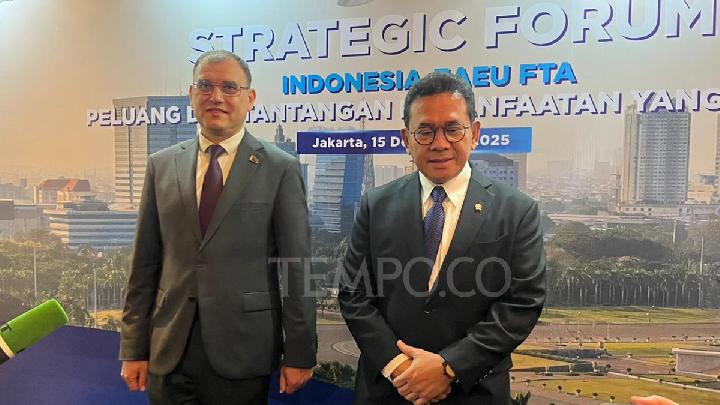
“Exports are expected to increase as we enter the EAEU market,” Budi said in Jakarta on Monday, December 15, 2025.
The government is currently finalizing negotiations on the trade agreement, which began in 2022. Indonesia plans to sign the deal on December 20 or 21, 2025, in St. Petersburg, Russia, or alternatively in the first quarter of 2026. Budi said the Ministry of Foreign Affairs has received an official invitation for the signing.
Following the signing, the agreement will be submitted to parliament for ratification before it can be implemented. Based on the Ministry of Trade’s timeline, the ratification process is expected to take place in the first or second quarter of 2026, with the agreement set to enter into force in the third quarter of that year.
“The agreement will open up significant market opportunities across EAEU member states, including Armenia, Russia, Belarus, Kyrgyzstan, and Kazakhstan,” Budi said.
Data from the Ministry of Trade show that Indonesia’s exports to Eurasian countries reached US$1.76 billion between January and October 2025, while imports during the same period totaled US$2.64 billion. Budi expressed optimism that Indonesia’s exports to the region could double once the free trade agreement takes effect.
Indonesia’s main exports to Eurasian countries currently include crude palm oil, coconut oil, coffee, cocoa and cocoa butter, as well as electronic products such as monitors and projectors.
The ministry expects exports to rise further, particularly for vegetable oils and fats, food products, and ready-made garments.
Under the agreement, import tariffs on several Indonesian products, including palm oil and its derivatives, footwear, shrimp, natural rubber, raw coffee beans, silk, and essential oils, will be eliminated once the deal comes into force.
In addition, tariffs on a broader range of Indonesian products will be gradually reduced to zero within three to 10 years. These include textiles and textile products, fish and fishery products, wood and wood-based goods, furniture, electrical machinery and equipment, food and beverage products, and basic chemicals.
Beyond boosting exports, Budi said the agreement would also improve access to key imports from Eurasian countries, particularly raw materials.
Indonesia’s main imports from the region include coal and briquettes, mineral and chemical fertilizers, ferroalloys, and semi-finished steel products.
If you want to order Indonesian Crude Palm Oil (CPO), you can order at Indonesian-Product.com.