
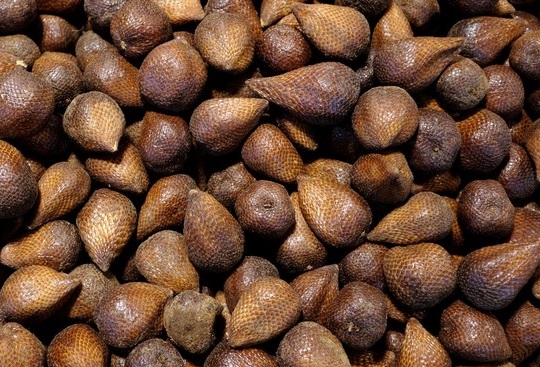
The Yogyakarta Animal, Fish, and Plant Quarantine Agency (BKHIT) revealed that snake fruit produced in Sleman is the most frequently exported commodity from Yogyakarta. However, to be shipped abroad, snake fruit requires quite a complicated inspection process!
The Head of the Yogyakarta BKHIT, Turhadi Noerachman, explained that until October 2025, Sleman snake fruit still ranks first among other Yogyakarta export commodities in terms of inspection requests. Fresh seafood is second only to him.
“As far as I know, the largest (commodities exported from Yogyakarta) are plants, both for export and between regions. Plant exports are boosted by snake fruit exports. Snake fruit exports are currently booming, at their peak. The last three months, up to December, New Year, and even Chinese New Year,” explained Hadi when met at the Yogyakarta BKHIT.
“After the new fish plants, fresh fish, yes. And that industry is mostly located around Central Java, so there’s a lot of fish because Central Java doesn’t have many flights to Singapore airport, so it’s being diverted to Kulon Progo,” he continued.
Hadi detailed that throughout 2025, at least until October, there will be around 300 shipments of snake fruit from Sleman abroad. China and Cambodia are the main destinations.
“The snake fruit comes from Sleman and Srumbung, Magelang. As of last October, my data shows that there were more than 300 shipments, totaling hundreds of tons, to China and Cambodia,” Hadi explained.
“I don’t know where from Cambodia, because as far as I know, Cambodia is actually a new market. But my assumption is that it’s going to Vietnam from Cambodia. Vietnam’s quarantine currently doesn’t allow Indonesian snake fruit to enter,” he continued.
It is known that export commodities must have a Quarantine Certificate from the National Quarantine Agency (BKN). In Yogyakarta, the Yogyakarta BKHIT, as a Technical Implementation Unit (UPT) under the BKN, is responsible for conducting inspections and quarantine before issuing the certificate.
The Yogyakarta Regional Health and Safety Agency (BKHIT) is also tasked with ensuring that export commodities from its territory comply with the quarantine standards of the destination country. This certificate is not only required for exports, but also for import and/or inter-regional product traffic.
“Technical services are certification services. Certification includes lab testing and quarantine. So, the context of certification services is everything from the application process to the issuance of documents,” explained Hadi.
For snake fruit, Hadi said, the inspection process for issuing a quarantine certificate is quite complicated. He explained that snake fruit samples must be inspected individually to ensure they are free of pests.
“For example, if we’re shipping 5 tons of snake fruit, the sample size is 10 percent, which means 500 kg. 1 kg contains an average of 12 seeds, multiplied by 500, that’s 6,000 seeds. Our officers inspect each seed individually. So, they inspect each fruit individually, checking for pests, including fruit flies, and touching each one,” Hadi explained.
“Secondly, China requires that if we want to export to China, the inspection must be carried out at the exporter’s warehouse. It must be in a safe condition, free from the possibility of pest infestation,” he continued.
Although this may seem complicated, Hadi said that his company still has a maximum service time limit, which depends on the risk level or Service Level Agreement (SLA).
This SLA is divided into three classifications based on risk level: high, medium, and low quarantine risk. Each has a different service time limit.
“For high risk, it usually depends on the difficulty of the pest or disease testing or contamination. But we’ve set a maximum limit for high risk, which is around 21 days,” he said.
“For medium risk, it’s calculated in hours. The longest, but limited, we have an SLA of three days. For medium risk, it’s the longest. For low risk, the maximum is one day,” Hadi added.
Hadi explained that snake fruit is categorized as high risk because it requires a fast inspection process. Furthermore, the large number of snake fruit that needs to be inspected is very large. Therefore, his office has a mobile service.
“There’s a lot of goods, and it’s impossible to take them directly to Kulon Progo via the airport. We can come and inspect the warehouse and so on. That’s what’s happening with salak these days. So, check them there,” he concluded.
If you want to order Indonesian Fruits especially Snake Fruit , please contact Indonesian-Product.com